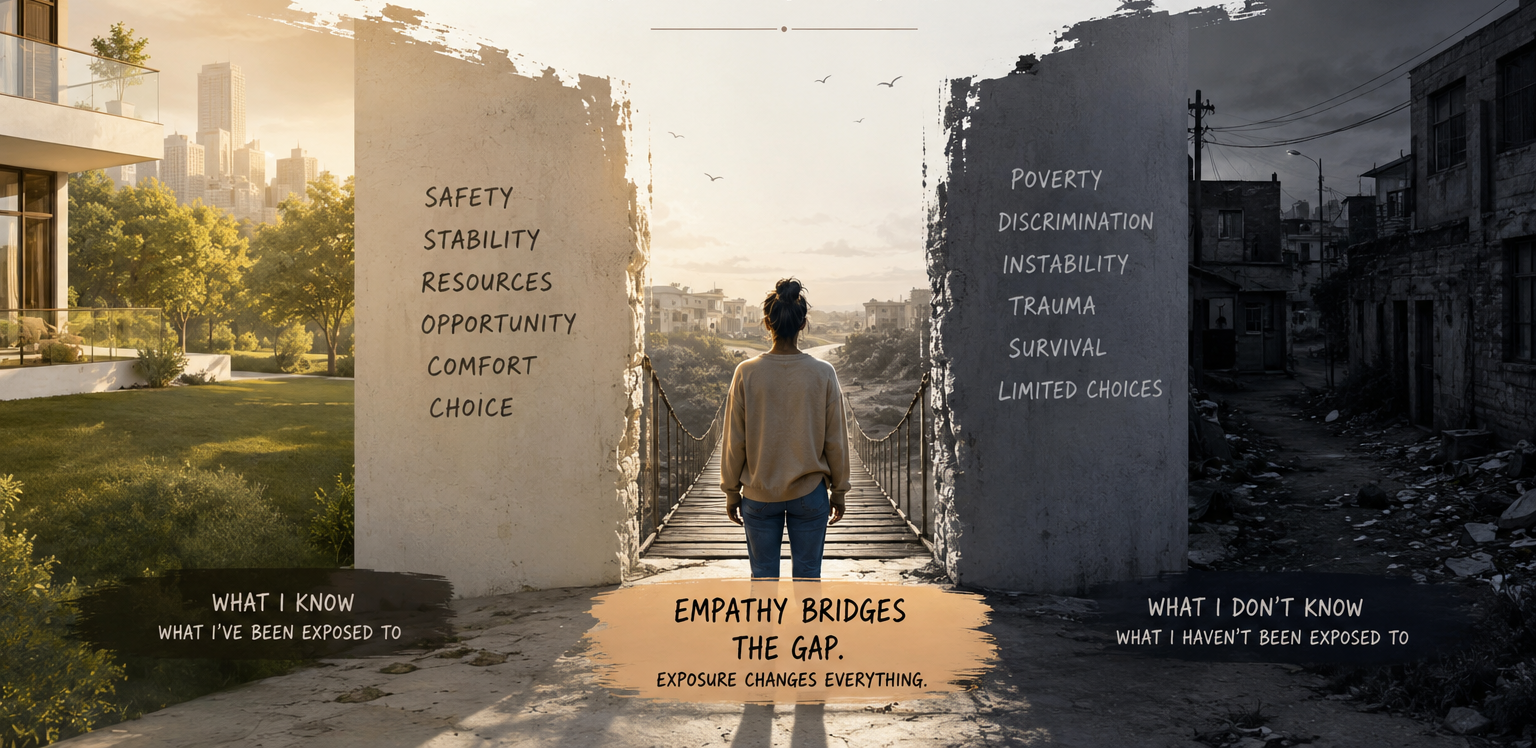
The Exposure Gap: Privilege, Morality and Mindset Shifts
This think piece (or opinion piece) emerged while I was studying for my Intercultural Communication quiz on Robin DiAngelo’s White Fragility. As I engaged with the ideas about racial discomfort, privilege, and defensive reactions, I found myself reflecting more broadly on how limited exposure shapes not only our understanding of race and racism, but also our moral judgments in general.
What began as notes on the concept that “morals are a privilege” evolved into a deeper exploration of the role of exposure, or the lack thereof, in forming our worldviews. A conversation overheard in the library, a powerful TikTok video by Karabo Nyalungu about “exposure difference,” and Jane Elliott’s groundbreaking “Blue Eyes/Brown Eyes” experiment, all converged to illuminate one central truth: many of our strongest moral positions are heavily influenced by the realities we have (or have not) been exposed to.
This piece examines how privilege often manifests as protected ignorance, how universities can serve as a powerful catalyst for meaningful mindset shifts, and why acknowledging exposure gaps is essential for developing greater empathy, humility, and fairness in how we judge others. It does not seek to excuse harmful behaviour or remove personal accountability, but rather to encourage a more nuanced understanding of why people see the world so differently, and why some find it easier than others to live according to certain moral ideals.
Morals are a Privilege
Last week, on Tuesday, a friend of mine told me of an interesting conversation they overheard. In the library, they overheard a conversation between a group of first years that piqued their interest. One of the students made a few statements that were valid to them, but one statement stood out that they did not agree with.
“Homeless people are homeless by choice.”
My friend believed that many factors contribute to someone being homeless, and most of the time, it is not of their own choice. This obviously led to us having our own discussion, and while some of the statements made by the student were valid, I believed that the student was speaking from a moral point of view.
Taking the comment about homeless people, we can assume that the student comes from a “good” background where their family is middle-class, somewhat wealthy. With this assumption, it makes sense why he made that statement, because he is coming from a place of privilege and ignorance, maybe due to a lack of exposure. It is easy for him (and everyone else) to judge others when they have never been in their shoes. Always on the outside looking in.
The same way people judge those who go into prostitution is because of their morals, and I believe that having morals is a privilege. What do I mean?
When we talk about morals, we talk about a person’s internal sense of right and wrong. The values that guide how they believe they should behave, like honesty, fairness, and respect. When I say, “having morals is a privilege,” I do not mean that some people have values and others do not. What I mean is that the ability to consistently “act” on those morals is not equal for everyone. It is important to understand that people do not all grow up learning the same version of these values. Different backgrounds, cultures, religions, traumas, and family dynamics shape what people see as “normal,” necessary, acceptable, or even moral.
For example, a child raised in a stable home where emotional openness and honesty are encouraged may grow up believing direct honesty is always morally correct. Meanwhile, someone raised in an abusive or survival-based environment may learn that hiding things, lying, or emotionally shutting down is necessary for protection and survival. Society may judge both people by the same moral standard, while ignoring that they were conditioned differently from the beginning.
Our understanding of morality, and our ability to consistently act on it, are shaped by our environment and circumstances. When someone has safety, stability, financial security, emotional support, education, and opportunities, they have more freedom to make choices based purely on principle. But when someone is in survival mode, their decisions are often shaped by necessity, fear, trauma, or lack of options. In that sense, the expression of morality can become a form of privilege, because not everyone has the same level of freedom in their choices.
For example, if someone ends up selling their body because they were disowned by their family because of their sexual orientation, saying “they should just find another job” can come from a place of privilege. It assumes that safe and realistic alternatives are available to everyone. It ignores how poverty, desperation, lack of support, abuse, unemployment, or systemic inequality can narrow a person’s options. From the outside, it can look like a simple choice, but for that person, it might be one of the only viable ways to survive at that moment because they are making decisions within conditions that other people have never had to experience.
Overall, it is not that morals themselves are a privilege; it is that the ability to consistently live them out can be, because people do not all have the same starting point or the same level of freedom in their decisions.
How does this link to White Fragility?
One of the main ideas in White Fragility is that many white people grow up in environments that protect them from racial discomfort and allow them to see their experiences, perspectives, and moral standards as “normal” or universal. Because of that protection, conversations about racism can feel like personal attacks rather than structural critiques. In a way, that is another example of how the expression of morality can be tied to privilege.
I believe everyone has a level of whiteness in them. Whiteness is and will always be associated with privilege.
Whiteness is not merely skin colour but a social process encompassing structural advantage, a standpoint, and a set of unmarked cultural practices that elevate white people over people of colour.
For instance, it is easier to strongly believe in ideas like “everyone should just work hard” or “everyone should make the right choices” when you have grown up in conditions where the system generally works in your favour, or where you have not had to constantly navigate barriers tied to race, poverty, or discrimination. Privilege can create distance from certain realities, and that distance can make moral judgment seem simple. So, when people from marginalised groups explain how systems, circumstances, or survival shape people’s decisions, defensive reactions can happen because it challenges the belief that everyone has equal freedom and equal opportunity to act morally in the same way.
I think the main point is that morality does not exist in a vacuum. People are shaped by what they have been taught, what they have survived, what opportunities they have had access to, and what systems they exist within. That does not mean accountability disappears or that harmful actions should always be excused, but it does mean we should be more aware and practice mindfulness of how privilege affects not only people’s choices but also their ability to judge other people’s choices from a distance.
Exposure Differences
Privilege comes from a lack of exposure. When someone grows up shielded from hardship, diversity, systemic barriers, or survival pressures, their worldview becomes narrow yet confident. They mistake their limited perspective for universal truth or strong moral clarity. This is why a first-year student from a stable, middle-class background can casually declare that “homeless people are homeless by choice” or that “people do not have to go into prostitution.” From their position of safety and stability, these statements feel like straightforward moral positions. In reality, they often reflect ignorance of the constrained choices many people must navigate daily.
The greatest structured environment for closing this exposure gap is universities. It serves as a powerful catalyst for mindset shifts because it deliberately forces individuals out of familiar circles and into sustained, everyday contact with difference.
This dynamic is powerfully illustrated in a South African TikTok video by Karabo Nyalungu (@karabodynamite). The creator explores the “exposure difference” between two people from similar high school backgrounds who end up on very different life paths. One attends university and experiences culture shock through diverse residences, lectures, and social spaces. They interact deeply for the first time with people of different races, cultures, religions, and sexual orientations. They confront and unlearn old stigmas and biases, learn about consent and respect, expand their benchmarks of success from local to national or global levels, and gain access to new ideas, networks, and long-term thinking through reliable Wi-Fi, libraries, and high-achieving peers.
In contrast, someone who stays in familiar environments often retains more limited perspectives, surface-level judgments, and locally benchmarked thinking. When the two reconnect years later, the gap in mindset, values, and life outcomes can feel stark and awkward.
University does not make people morally superior. Rather, the combination of safety, stability, education, and diverse exposure gives individuals greater psychological freedom to consistently act on principles such as honesty, fairness, and empathy. It disrupts the insulation that privilege creates and makes rigid, black-and-white moral judgments much harder to sustain. It cultivates humility: the understanding that people’s choices are shaped by what they have been taught, what they have survived, the opportunities they have accessed, and the systems they must navigate.
Jane Elliott’s “Blue Eyes/Brown Eyes” Experiment: Forced Exposure in Action
A striking practical demonstration of how exposure can challenge privilege and reveal the mechanics of racism is Jane Elliott’s famous “Blue Eyes/Brown Eyes” exercise. Originally conducted in 1968 with her all-white third-grade class in Iowa, the day after Martin Luther King Jr.’s assassination, Elliott divided her students by eye colour, an arbitrary trait, and assigned superiority or inferiority to each group on different days.
The results were dramatic: the “superior” group quickly became arrogant and discriminatory, while the “inferior” group became withdrawn, performed worse academically, and internalized feelings of worthlessness. Decades later, Elliott replicated versions of this exercise with adults, most notably in the 2009 Channel 4 documentary The Event: How Racist Are You?, where she subjected a diverse group of British adults to the same eye-colour-based discrimination.
This experiment directly relates to the concepts of white privilege and White Fragility. It shows how quickly arbitrary social categories can create real power imbalances, emotional harm, and behavioural changes. It demonstrates that exposure to the lived feeling of discrimination, even briefly and artificially, is far more effective at building empathy and awareness than abstract lectures. It reveals how privilege insulates people from discomfort and how easily humans can internalize and perpetuate hierarchies.
Conclusion
Morality does not exist in a vacuum. Acknowledging exposure differences does not eliminate personal accountability, but it demands greater mindfulness and humility when we judge others’ choices from a distance. Whether through university, deliberate exercises like Jane Elliott’s, or intentional efforts to seek out unfamiliar realities, expanding our exposure remains one of the most powerful ways to turn privilege into awareness and judgment into understanding.